The Supply-Side Illusion: Why AI Isn't Making Anything Cheaper (Yet)
AI is crushing the cost of intelligence. Your groceries, rent, and healthcare haven't noticed.
I spend my days building machine learning systems. I watch inference costs drop by an order of magnitude every year. I see a single engineer accomplish what used to require an entire team. The raw cost of thinking—of generating code, analyzing data, writing reports—is plummeting toward zero.
And yet. My rent went up. My health insurance went up. A bag of groceries costs the same as it did two years ago. If AI is making everything cheaper to produce, why isn't anything actually cheaper to buy?
This is the central paradox of the AI economy, and if we don't understand it clearly, we're going to be blindsided by what comes next.
The Paradox of Plenty
The conventional wisdom has always been simple: automation increases productivity, productivity makes things cheaper, cheaper things create abundance. It worked with the printing press. It worked with the assembly line. It worked with the microchip.
But AI is doing something different. It's automating cognitive labor, not just physical labor. And it's doing it at a pace that outstrips every previous technological revolution. The result is a strange and uncomfortable situation: supply is getting dramatically cheaper to produce, but the demand side of the equation is fracturing.
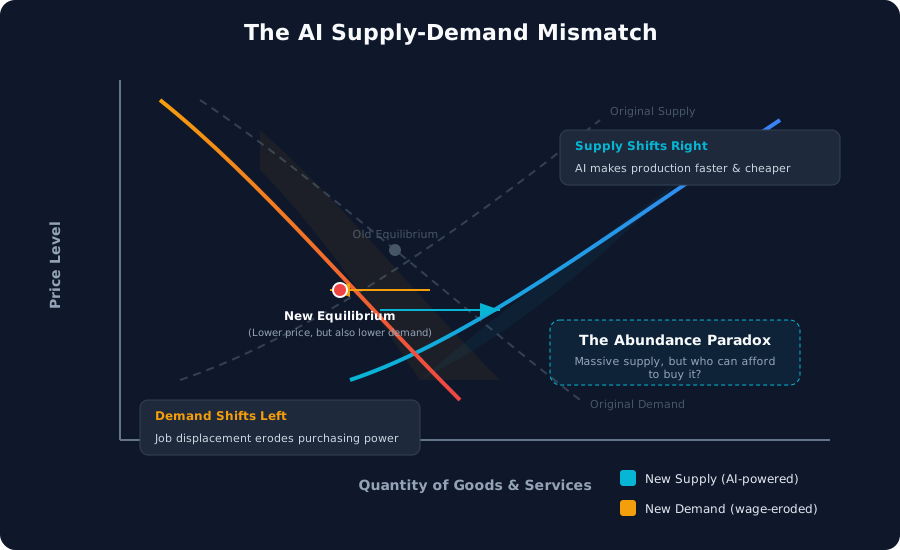
If companies can produce goods and services with fewer humans, that means fewer humans earning wages. Fewer wages means less consumer spending. Less consumer spending means the demand for all those cheaply-produced goods starts to evaporate. The economic engine doesn't just slow down—it starts running on fumes.
Five Reasons Prices Haven't Dropped
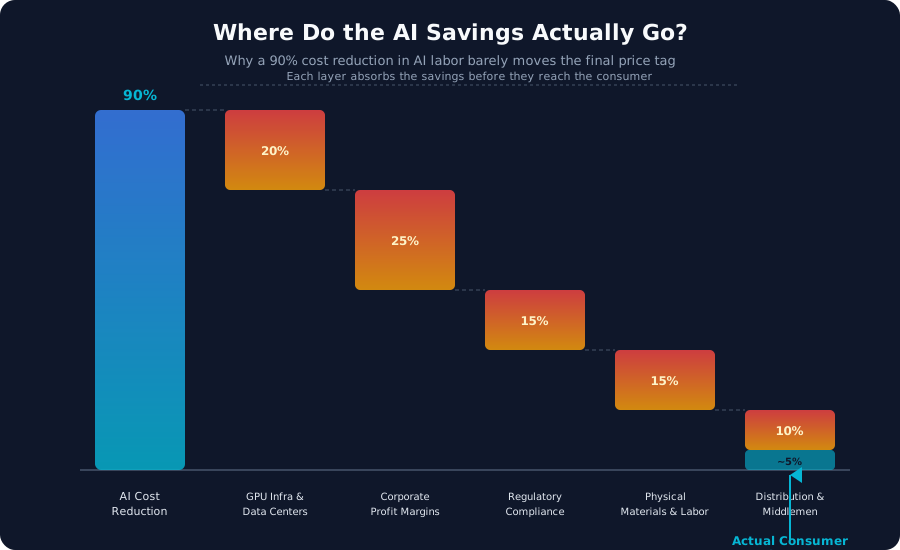
So the cost of production is falling. But the price on the shelf is the same. Where is the disconnect? There are five structural forces keeping prices stubbornly sticky.
1. AI infrastructure is absurdly expensive
The irony is thick: while AI makes human labor more efficient, the AI itself is not cheap. Running large models requires massive data centers packed with specialized GPUs, consuming enormous amounts of electricity. The companies building and deploying AI are spending billions on infrastructure, and they need to recoup those investments. That means they're highly motivated to keep prices exactly where they are—or raise them—rather than passing savings to you.
2. Companies are pocketing the savings
When a company uses AI to replace a 20-person customer service team with an automated agent, their operational costs drop immediately. But in the current corporate environment, the default move is not to lower the product price. The default is to keep the price the same and report record profit margins to shareholders.
Price wars only happen when a competitor forces the issue. And in many modern industries—tech, banking, telecom, healthcare—markets are consolidated into oligopolies. When three or four massive companies control an industry, they implicitly agree to keep prices high and pocket the AI-driven savings.
3. The physical world doesn't care about your AI
AI is brilliant at collapsing the cost of digital coordination. But we don't live in a purely digital world. If you use AI to design a building in 10 minutes instead of 10 weeks, you've saved a fortune on architecture. But you still need concrete, zoning permits, plumbers, and land. If you use AI to optimize a global supply chain, you still pay for diesel fuel, cargo ships, and warehouse space.
The physical components of the economy are still constrained by real scarcity. AI's digital savings are often just acting as a buffer against the rising costs of physical materials.
4. Sticky prices are a real phenomenon
Economists have long observed that prices go up quickly during inflation but are agonizingly slow to come down when costs drop. Consumers are already conditioned to pay the higher price. Companies have no incentive to break the spell. So prices stay inflated long after the underlying cost structure has shifted.
5. Jevons Paradox strikes again
There's a counterintuitive economic principle at play: when technology makes a resource more efficient, the total consumption of that resource often increases. Because AI makes it cheaper to produce software, content, and analysis, companies just demand more of it. The market expands to absorb the efficiency gains, keeping overall demand—and prices—high.
The Three-Phase Timeline
So when does the price crash actually happen? The answer depends on which part of the economy you're looking at. I think about this in three distinct phases.
Phase 1: The Digital Price War (Now to ~2028)
Knowledge work automation will cause brutal price wars, but only in industries where information is the final product. Legal contract review. Copywriting. Graphic design. Basic software development. In these sectors, the barrier to entry is dropping to near zero. A solo founder armed with AI agents can already do the work of a 50-person agency. The price of purely digital services will crash.
Phase 2: The Hybrid Bottleneck (~2028-2032)
Industries that require both knowledge work and physical execution will see partial cost drops. Consider healthcare: AI can already analyze medical images with superhuman accuracy. The cost of diagnosis and administration drops dramatically. But the patient still needs a physical hospital bed, a nurse to draw blood, a surgeon in the operating room. The digital overhead gets cheaper, but the physical reality keeps the overall bill stubbornly high.
Phase 3: The Physical Crash (2030s)
True abundance—where housing, food, physical goods, and healthcare all become radically cheaper—requires AI to be embodied in the physical world. Humanoid robots pouring concrete and assembling structures 24/7. Autonomous trucks and automated warehouses slashing logistics costs. Surgical robots performing procedures at scale. This is when the cost of doing, not just the cost of planning, finally collapses.
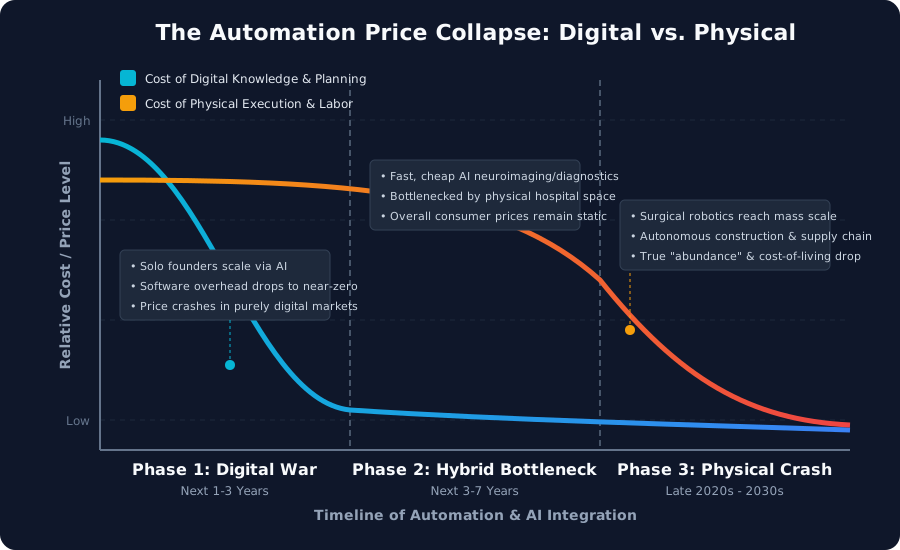
We are currently watching the price of planning drop to zero, while the price of doing remains the same.
Bridging the Gap: What Could Work
If the technology is eroding jobs and wages today, but the cost-of-living crash is years away, we're stuck in a dangerous transition period. Several structural shifts are being debated to bridge this gap.
Universal Basic Income. A regular, unconditional cash payment to all citizens regardless of employment status. It ensures a baseline level of consumer demand to keep the economic engine running. Not a radical idea—just a recognition that if machines do the work, humans still need purchasing power.
The Robot Tax. If a company replaces a human worker with an AI agent, it pays a tax equivalent to a portion of the income tax that human would have paid. Revenue funds social safety nets. It's elegantly simple: tax the machine, fund the human.
Shorter Workweeks. If society needs less human labor, distribute the remaining work across more people. A 4-day or even 3-day workweek without pay reduction keeps employment higher and spreads the benefits of productivity gains more broadly.
Radical Deflation. The optimistic, market-driven view: if AI eventually automates everything—medicine, legal, farming, construction—the amount of money you actually need to survive drops so low that even minimal work covers a very high standard of living. In this world, the problem solves itself. Eventually.
The Dangerous Part Is the Middle
The technology is advancing at an exponential rate. Our economic and political systems move at a glacial pace. We're in the transition phase right now: AI is eroding jobs and wages today, but the safety nets and the radical cost reductions haven't arrived yet.
Abundance is coming. The timeline for that abundance is visible. But the path between here and there is where things get rough.
In the next essay, I explore the other side of this equation: if you're building in this landscape, how do you position yourself? How do incumbents fight back? And what does it actually mean to sell outcomes instead of software?