Surviving the Commoditization Wave: AI Market Strategy for Builders
When the cost of intelligence hits zero, what's left to sell?
This is Part 2 of a two-part series. Read Part 1: The Supply-Side Illusion: Why AI Isn't Making Anything Cheaper (Yet)
In the previous essay, I looked at why AI-driven cost reductions aren't reaching consumers yet. Now I want to flip the lens: if you're someone who builds things—a founder, an engineer, a product thinker—what does this landscape actually mean for you?
The short answer: the rules of the game are changing, and most people haven't updated their playbook.
The Death of the Per-Seat Model
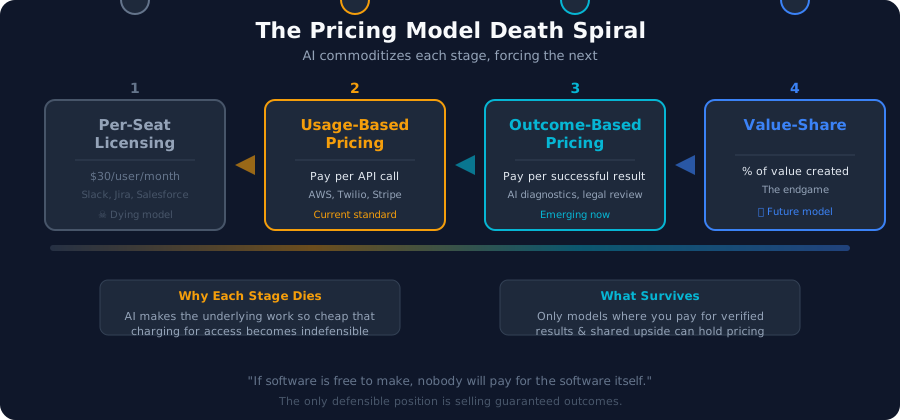
For decades, the Western software economy has been built on selling seats. $30 per user per month for project management. Thousands per year for enterprise analytics. The entire SaaS model assumes that software is expensive to build, so companies can charge a premium for access.
That assumption is dying. When anyone can use an open-source model to spin up a custom tool over a weekend, those high margins collapse. The only way to make a billion dollars won't be to sell a $1,000 product to a million people. It'll be to sell a $1 product to a billion people.
The "Good Enough" Crisis
Here's what keeps legacy companies up at night: if an incumbent offers a product for $100 and a new AI-powered startup offers something 95% as good for $1, the market will flock to the $1 product. Brand loyalty evaporates when the price difference is two orders of magnitude.
This creates a brutal dynamic. To survive, companies will have to innovate constantly just to tread water. You can't rest on a feature for three years; you'll need to update it in three weeks. This is a nightmare for bloated corporations, but a golden age for the consumer.
The Middleman Gets Eliminated
The companies that will sink fastest are those whose entire business model is routing information from point A to point B. Think about the administrative bloat in healthcare, legal discovery firms, outsourced customer service centers. When AI can ingest, route, and execute on data instantly, the economic value of these intermediaries drops to zero. The market will correct brutally.
The Solo Founder Advantage
This new reality creates an unprecedented structural advantage for lean operators.
Imagine you're building something highly specialized—say, an automated neuroimaging analysis platform. In the old economy, you'd need millions in seed funding just to hire developers, researchers, and sales reps. Your overhead would force you to charge premium prices.
In the AI-driven volume economy, a solo founder can architect the entire software stack using AI agents. Because you don't have a 500-person payroll or corporate bloat, your overhead is near zero. You can enter the market, offer your platform at a fraction of the incumbent's price, and immediately capture volume. The big players physically cannot lower their prices to match yours without going bankrupt, because their legacy cost structure won't allow it.
The biggest moat in the next decade won't be capital or brand. It'll be the ability to operate at near-zero overhead while everyone else drowns in legacy costs.
Selling Outcomes, Not Software
If software is essentially free to make, nobody will pay for the software itself. The surviving businesses will stop selling tools and start selling guaranteed results.
Instead of selling a hospital a monthly subscription to an MRI analysis tool, the new model says: "We will process and diagnose 10,000 scans, and you only pay us a fraction of a cent per accurate diagnosis." The revenue is entirely aligned with the customer's success. It becomes a pure volume game.
This is terrifying for incumbents. Their entire revenue model is built on recurring subscriptions regardless of whether the customer actually gets value. Switching to outcome-based pricing would immediately cannibalize their own revenue stream. They literally can't follow you there.
The Incumbent Fortress
Don't underestimate the other side. The massive incumbents—Big Tech, legacy healthcare platforms, enterprise software giants—are not going to simply surrender their margins. They have a very specific playbook to defend their territory.
Regulatory Capture
This is their most powerful weapon. Massive corporations will lobby governments to heavily regulate AI under the banner of "safety" or "national security." If you're building a medical AI platform, the legacy players will push for compliance certifications that cost millions and take years to acquire. They can afford the lawyers; a solo founder cannot. It's a deliberate strategy to raise the barrier to entry and starve new competition.
Predatory Pricing
A tech giant with billions in cash reserves can give away an AI tool for free or at a massive loss for years. The goal is to completely dehydrate the market, bankrupt the agile startups that can't survive without revenue, and build total user dependency. Once the competition is dead and switching costs are too high, they crank up the fees. Classic bait and switch.
The Distribution Chokehold
Incumbents don't always win by having a better product. They win because they already own the customer relationship. A legacy software provider integrated into a thousand hospitals doesn't need the best AI. They just need AI that's "good enough" and bundle it into their existing contracts so the customer never has a reason to look elsewhere.

The Startup Counter-Playbook
Despite these massive defenses, the status quo is vulnerable—but only to a very specific type of disruption. If a startup tries to compete on general-purpose AI, they'll be crushed by scale. To win, you need structural moats that oligopolies cannot touch.
Counter-Position: Attack the Business Model
Offer outcome-based pricing that the incumbent literally cannot match without cannibalizing their own revenue. If they charge $10,000/month for a platform and you charge $0.01 per successful result, they face financial suicide trying to follow you. Your business model itself becomes the moat.
Go Deep Vertical
Incumbents build horizontal tools that do a hundred things decently. Startups win by going impossibly deep into one specific vertical. Don't sell "AI." Sell an end-to-end workflow where the AI completely disappears into the job-to-be-done. If you solve a highly specific, painful problem perfectly, the switching costs for the user become psychological. They won't want to go back to the clunky, bundled alternative.
Speed as a Weapon
Massive companies have immense resources, but they're paralyzed by consensus, legal reviews, and quarterly earnings pressure. A solo founder or micro-team can iterate on a product daily, pivot based on direct user feedback, and ship features before an incumbent has finished scheduling their first committee meeting about the threat.
The Window Is Open
We are in a rare moment. The cost of building has collapsed, but the market hasn't fully adjusted yet. Incumbents are still slow. Consumers are still looking for alternatives. The regulatory walls haven't fully gone up.
This window won't stay open forever. The incumbents will adapt. The regulations will arrive. The market will consolidate again, as it always does.
But right now, a builder with the right focus, the right vertical, and the willingness to sell outcomes instead of seats can carve out a position that will be extremely difficult to dislodge.
The question isn't whether the commoditization wave is coming. It's already here. The question is whether you're the one riding it or the one being swept away.